
International
India’s Sharp Reply To Pakistan Signals A Stronger Line On Internal Matters
The crux of India’s response is not just diplomatic rejection. It is a clear message that New Delhi will strongly push back against Pakistan’s comments on India’s internal affairs.


New Delhi, June 21: India has strongly rejected the Pakistan President’s remarks on India’s internal matters, calling them unwarranted, absurd and politically motivated.
Responding to media queries, Ministry of External Affairs spokesperson Randhir Jaiswal said Pakistan had no locus standi to comment on issues that are internal to India. The response came after remarks made by the President of Pakistan, which New Delhi viewed as an attempt to interfere in India’s domestic affairs.
The MEA also pointed to Pakistan’s own human-rights record and its treatment of minorities, saying the remarks appeared less like genuine concern and more like a political attack.
The Crux
The crux of this news is that India’s response goes beyond a routine diplomatic rebuttal.
New Delhi is drawing a clear red line: Pakistan should not comment on matters India considers internal. This has been a consistent Indian position, especially when Islamabad raises issues related to India’s domestic politics, religious matters or constitutional decisions.
What makes this response sharper is the language used by the MEA. By calling the remarks “unwarranted,” “absurd” and politically driven, India is not merely disagreeing with Pakistan. It is questioning Pakistan’s moral and diplomatic authority to raise such issues in the first place.
This is where the story becomes important. The dispute is not only about one statement by the Pakistan President. It reflects the larger pattern of India-Pakistan diplomatic exchanges, where domestic matters often become international talking points.
Why It Matters
This matters because India is trying to control the narrative around its sovereignty and internal decision-making.
Whenever Pakistan comments on Indian domestic issues, especially those linked to religion, minorities or constitutional questions, India usually responds by framing it as external interference. The latest MEA response follows the same line, but with stronger wording.
India’s argument is simple: a country facing global criticism over its own minority rights and human-rights record cannot lecture India on internal matters.
This position serves two purposes.
First, it rejects Pakistan’s claim to speak on Indian issues. Second, it shifts the spotlight back on Pakistan’s own domestic challenges, especially the treatment of minorities across different faiths.
For India, this is also about preventing Pakistan from internationalising issues that New Delhi wants to keep within its sovereign framework.
The Bigger Picture
India-Pakistan relations have remained tense for decades, and public statements from either side often carry diplomatic weight beyond the immediate issue.
This response shows that India is increasingly unwilling to let Pakistan’s remarks pass without a strong counter. The MEA’s language suggests that New Delhi wants to close the door on any external commentary that questions India’s handling of its internal matters.
The larger picture is also about international perception. Pakistan often tries to raise India-related issues on global platforms, while India responds by pointing to terrorism, minority rights concerns and human-rights issues within Pakistan.
In this case, India’s reply frames Pakistan’s remarks as part of a political pattern rather than an isolated comment.
That framing is important because it allows New Delhi to present the issue not as a religious or domestic debate, but as a sovereignty and diplomacy matter.
What India Is Signalling
India is signalling three things through this response.
First, it will not accept Pakistan’s commentary on India’s internal affairs.
Second, it will counter such remarks by questioning Pakistan’s own record.
Third, it wants the international community to see Pakistan’s comments as politically motivated rather than principled.
This is a familiar but significant diplomatic strategy. Instead of only denying the allegation or responding to the specific remark, India challenges the credibility of the country making the comment.
Why The Language Is Important
Diplomatic statements are usually carefully worded. So when terms like “absurd,” “political attack,” “bigotry” and “hatred” are used, it shows a deliberate hardening of tone.
This indicates that India does not want the issue to be treated as a minor exchange of statements. It wants to send a message that repeated comments from Pakistan on India’s internal matters will be met with direct and forceful responses.
The wording also reflects India’s broader frustration with Pakistan’s repeated attempts to frame Indian domestic issues for international attention.
Final Takeaway
The real crux of this news is that India is not just rejecting one statement. It is reinforcing a wider diplomatic principle: Pakistan has no standing to comment on India’s internal affairs.
By linking the Pakistan President’s remarks to Pakistan’s own human-rights record and minority issues, India has turned the criticism back on Islamabad.
The story matters because it shows how India is shaping its diplomatic response in a more assertive way — defending sovereignty, rejecting external commentary and keeping the focus on Pakistan’s credibility.

Economy
Venezuela Earthquake Is Not Just About Oil Prices – It Exposes India’s Energy Security Challenge
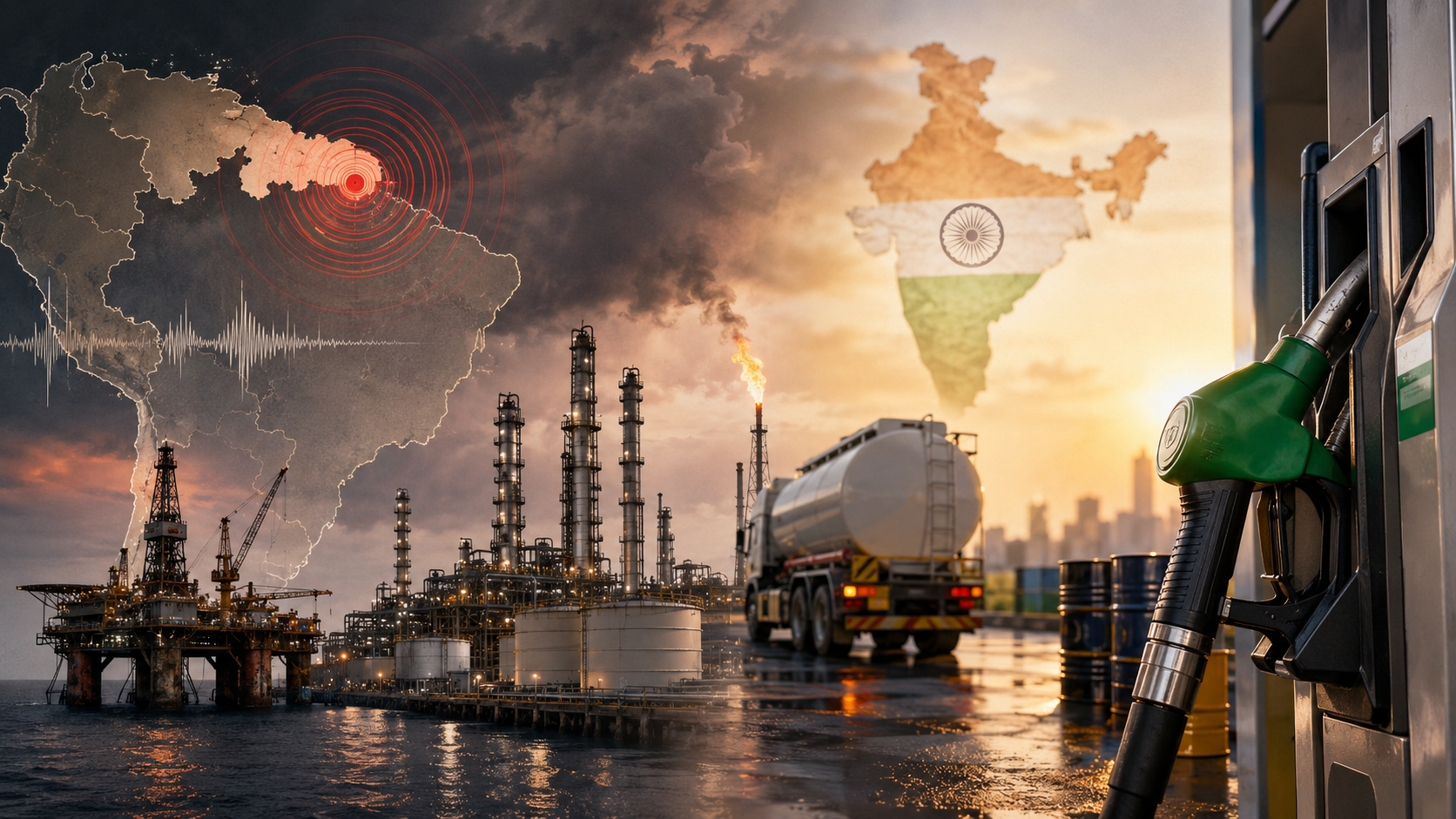
The powerful earthquakes in Venezuela have triggered a fresh question for Indian consumers: can a disaster in South America make petrol and diesel costlier in India?
The simple answer is that an immediate price shock is unlikely unless the earthquake causes major, lasting damage to Venezuela’s oil production, ports, power systems or export routes. But the deeper answer is more important.
The Venezuela quake has reminded India that fuel prices at home are no longer shaped only by what happens in the Middle East. They are also linked to how India diversifies crude oil supplies from Russia, the United States, Africa, Latin America and other distant markets.
That is where the story becomes bigger than one earthquake.
The Crux
The crux of this news is not panic at the petrol pump. It is India’s growing exposure to a more complicated oil world.
For decades, India’s biggest crude oil concern was West Asia. If tensions rose near the Strait of Hormuz, the fear was immediate: shipping disruption, higher crude prices and pressure on petrol and diesel rates.
But India’s energy map has changed. As global conflicts, sanctions and supply disruptions reshape oil trade, India has been looking for more suppliers outside its traditional routes. Venezuela has again become part of that conversation.
Venezuela matters because it holds massive crude reserves and has traditionally supplied heavy crude that Indian refineries can process. India’s advanced refining system, especially private and coastal refineries, can turn difficult heavy crude into useful fuels such as diesel, petrol and aviation turbine fuel.
So when an earthquake hits Venezuela, the concern is not just humanitarian or geological. Energy markets also watch whether oilfields, export terminals, power grids, ports and shipping routes are affected.
If the damage remains limited, India may not feel much impact. But if Venezuelan exports are disrupted for weeks, it could reduce one of India’s important backup supply options at a time when the global oil market is already sensitive.
Why It Matters For India
India imports most of the crude oil it consumes. That means even a distant disruption can matter if it affects global supply sentiment.
Petrol and diesel prices in India do not move only because of one country. They are influenced by a chain of factors: Brent crude prices, rupee-dollar exchange rate, shipping cost, refinery margins, taxes, oil marketing company recoveries and government pricing decisions.
This is why a Venezuela earthquake does not automatically mean Indian fuel prices will rise. The connection is indirect.
First, markets will check whether Venezuelan oil production has been hit. Second, they will assess if export terminals and shipping operations are functioning. Third, traders will calculate whether global supply is tight enough for this disruption to matter. Only after that does the impact move toward crude prices, and eventually to Indian fuel economics.
In short, the pump price impact depends on the scale and duration of disruption, not just the earthquake headline.
The Bigger Picture
The bigger picture is India’s energy diversification strategy.
India has been trying to avoid overdependence on any single region. This is why crude imports now come from a wider basket of suppliers. When one region becomes unstable, India looks elsewhere. When one route becomes risky, refiners search for alternative barrels.
Venezuela fits into this strategy because it gives India another option outside West Asia. But it also comes with risks: distance, sanctions history, political uncertainty, infrastructure weakness and now disaster-related vulnerability.
That is the real contradiction. Diversification reduces one type of risk, but creates new dependencies in new geographies.
If India buys more oil from Venezuela, a South American crisis becomes more relevant to Indian fuel security. If India buys more from Russia, geopolitical sanctions become more relevant. If India relies heavily on West Asia, shipping chokepoints become more relevant.
Energy security is no longer about finding one safe supplier. It is about managing many imperfect suppliers at the same time.
Will Petrol And Diesel Prices Rise?
At this stage, a direct and immediate rise in petrol and diesel prices in India because of the Venezuela earthquake is not certain.
For prices to move meaningfully, three things would need to happen.
First, Venezuela’s oil production or export infrastructure would need to suffer serious damage. Second, the disruption would need to last long enough to tighten global crude supply. Third, Indian oil companies and the government would need to pass higher crude costs to consumers instead of absorbing or delaying the impact.
If these conditions do not happen together, Indian consumers may not see any direct change at the pump.
However, if crude prices rise globally because traders fear supply shortage, India’s import bill can still come under pressure. That can affect inflation, the rupee, oil company margins and eventually fuel pricing decisions.
Why The Timing Is Sensitive
The timing matters because the global oil market has already been dealing with geopolitical pressure.
Any additional supply-side fear, even from a region far from India, can create volatility. Oil markets often react not only to actual damage, but also to risk. If traders believe supply may be affected, prices can rise before the full damage assessment is complete.
For India, this creates a familiar problem. Even when there is no shortage at petrol pumps, higher crude prices increase the cost of imports. That cost has to be absorbed somewhere — by oil companies, by the government, by consumers, or through a mix of all three.
This is why fuel prices are not just an energy issue. They are an inflation issue, a household budget issue and a macroeconomic issue.
What The Government Will Watch
Indian policymakers and oil companies will likely track four signals closely.
The first is whether Venezuelan oilfields and export terminals remain operational.
The second is whether power outages or damaged infrastructure slow production.
The third is whether crude prices rise globally after the quake.
The fourth is whether alternative suppliers can fill any gap if Venezuelan shipments are delayed.
If these signals remain stable, India’s fuel market may avoid any major shock. But if the disruption widens, the pressure will show up first in crude import costs before it reaches retail prices.
What Consumers Should Understand
For Indian consumers, the key point is this: petrol and diesel prices do not rise simply because a disaster happens in an oil-producing country.
They rise when that disaster affects supply, pushes up international crude prices, increases import costs and finally gets passed into domestic pricing.
That process takes time and depends on policy choices.
So the smarter way to read this news is not as “petrol prices will rise tomorrow.” The better reading is: “India’s fuel stability depends on a global supply chain that can be disturbed by wars, sanctions, shipping disruptions and even natural disasters thousands of kilometres away.”
Final Takeaway
The real crux of the Venezuela earthquake story is not immediate fuel panic. It is the fragility of India’s energy security in a world where every oil supplier carries some form of risk.
Venezuela gives India an important diversification option, especially when traditional supply routes face pressure. But the earthquake shows that even backup suppliers are not risk-free.
For now, Indian petrol and diesel prices may not see a direct shock unless Venezuela’s oil infrastructure suffers serious and prolonged disruption. But the episode is a reminder that India’s fuel future depends not only on buying crude cheaply, but on building a resilient, flexible and diversified energy system.
The pump may look local, but the price behind it is global.
International
India’s BRICS NSA Meet Puts New-Age Security Threats At The Centre
The crux of the BRICS NSA meeting is not just diplomatic participation. It signals how India wants to place terrorism, cyber risks and emerging technologies at the centre of BRICS security cooperation.

New Delhi, June 21: India is set to host the BRICS National Security Advisers’ Meeting on June 22 and 23, with National Security Adviser Ajit Doval chairing the two-day security dialogue.
National Security Advisers and heads of delegation from BRICS member countries are expected to deliberate on the theme, “Non-Traditional Security Challenges Confronting The World Today.”
The agenda is expected to focus on how global security threats are changing beyond conventional military conflict. Issues such as terrorism, cyber threats, misuse of technology, information security, emerging digital risks and complex transnational challenges are likely to remain at the centre of discussions.
The Crux
The real importance of this meeting lies in the timing and the theme.
BRICS is no longer only an economic grouping discussing trade, development and finance. With its expanded membership and growing geopolitical weight, the platform is increasingly becoming a space where countries discuss security, technology and strategic coordination.
India hosting this meeting gives New Delhi an opportunity to shape the BRICS security conversation around issues it has repeatedly flagged on global platforms — especially terrorism, cross-border threats, cyber misuse and the security impact of emerging technologies.
The phrase “non-traditional security challenges” is important because it widens the debate. Security today is not limited to borders, armies or weapons. A cyberattack can disrupt banking systems. Misinformation can create instability. Terror networks can use encrypted platforms. Artificial intelligence, drones and digital tools can be used for both development and disruption.
That is the broader challenge this meeting is expected to address.
Why It Matters
This BRICS NSA meeting matters for India on three levels.
First, it strengthens India’s position as a security agenda-setter within the Global South. By chairing the meeting, India can push conversations that go beyond broad diplomatic statements and focus on practical security cooperation.
Second, the meeting comes at a time when technology is changing the nature of conflict. Cyberattacks, data theft, AI-enabled threats, digital radicalisation and misuse of information networks are becoming serious concerns for governments. A platform like BRICS allows member countries to compare threat perceptions and explore common responses.
Third, counter-terrorism remains a core Indian concern. For India, any multilateral security discussion is also a chance to call for stronger global consensus against terrorism, terror financing and safe havens. Within BRICS, where member countries may not always have identical geopolitical interests, building agreement on security language itself becomes significant.
The Bigger Picture
The BRICS grouping has expanded beyond its original five members and now includes major emerging economies across Asia, Africa, West Asia and Latin America. This gives the platform greater reach, but also makes consensus more complex.
That is why a security meeting of this kind carries weight. It is not just about one event in New Delhi. It is about how BRICS defines its role in a world where traditional power structures are being challenged and new forms of instability are emerging.
For India, the meeting is also part of a larger diplomatic moment. As host, India can position itself as a country that is not only participating in BRICS, but actively shaping its future agenda.
The discussions on counter-terrorism and security in the use of information and communication technologies are especially relevant. These are two areas where global coordination is often difficult, but increasingly necessary.
What To Watch
The key thing to watch will be whether the meeting produces a sharper common understanding on terrorism, cyber security and technology-driven threats.
Another important area will be the tone of participation from major BRICS members, especially as the grouping includes countries with different strategic alignments. The ability to find common language on security will show how far BRICS can move beyond economic cooperation into strategic coordination.
If the meeting results in stronger agreement on counter-terrorism, cyber safety and responsible technology use, it could become an important marker in India’s BRICS 2026 leadership.
Final Takeaway
The crux of the news is that India is using the BRICS NSA platform to bring attention to the next generation of security threats.
This is not just a routine diplomatic meeting. It reflects a changing global security landscape where threats are faster, more digital, more networked and often harder to trace.
By hosting the meeting, India is placing itself at the centre of a conversation that every major country now has to confront: how to protect societies when security threats no longer come only through borders, but also through technology, networks, information systems and non-state actors.
Image Source: File Photo / Provided Image
International
UN Chief Highlights Yoga’s Ancient Indian Roots On International Yoga Day
UN Secretary-General António Guterres said yoga, rooted in ancient India, has become a universal practice that helps people find calm, build strength and live with purpose.

New Delhi, June 21: United Nations Secretary-General António Guterres highlighted yoga’s ancient Indian roots on the occasion of International Yoga Day, saying the practice has become truly universal and continues to help millions of people across faiths and cultures.
In a message shared on X, Guterres said yoga, which originated in ancient India, has grown into a global movement that helps people find calm, build strength and live with purpose.
He said yoga teaches mindfulness, respect and care — not only for ourselves, but also for the planet and for one another.
The UN chief also connected his message with this year’s International Yoga Day theme, “Yoga for Healthy Ageing,” saying the world must extend care to older members of the human family.
He called for building a world where every generation can lead a healthy life with dignity, balance and well-being.
International Yoga Day is observed every year on June 21 and has become one of the world’s most widely recognised wellness observances. The day celebrates yoga as a practice that promotes physical health, mental calmness, emotional balance and harmony among people.
Guterres’ message underlined yoga’s growing global relevance, especially at a time when conversations around healthy ageing, mindfulness and sustainable living are becoming increasingly important.
The statement also reflects the global acceptance of yoga as a practice that connects ancient Indian wisdom with modern health and wellness needs.
International
Train Collision North Of London Leaves One Dead, Dozens Injured
A collision between two passenger trains near Bedford, north of London, killed one train driver and left dozens injured, including several in critical condition.

London, June 20: One person was killed and dozens were injured after two passenger trains collided near Bedford, around 100 kilometres north of London, officials said.
The collision took place on Friday evening near Bedford, involving two East Midlands Railway services travelling towards London St Pancras. Emergency services rushed to the site soon after the crash and a major response operation was launched.
According to reports, the driver of one of the trains died at the scene. Several passengers were injured in the impact, with some requiring hospital treatment. Authorities later said that nine people remained in critical condition, while several others continued to receive medical care.
Initial emergency service figures said 11 people suffered very serious injuries, 22 sustained serious injuries and 56 others had minor injuries. More than 80 people were treated in hospitals following the crash.
The trains involved were reportedly operating on routes from Corby and Nottingham towards London St Pancras when the collision occurred. Visuals from the scene showed emergency workers, police and rescue teams near the damaged trains.
British Prime Minister Keir Starmer described the incident as devastating and expressed condolences to the victim’s family. King Charles III also conveyed sympathy to those affected by the crash.
British Transport Police and rail accident investigators have launched an investigation to determine the cause of the collision. Officials have urged the public to avoid speculation until the inquiry establishes the sequence of events.
Rail services in the affected section were disrupted after the crash, with passengers advised to check travel updates before planning journeys.


Jaishankar says India–US partnership is deepening amid complexities, with India expanding and diversifying its interests while pursuing strategic autonomy in a turbulent world.
June 20, New Delhi:
India’s External Affairs Minister Dr. S Jaishankar holds discussions at the India–US Forum 2026 in New Delhi.
Jaishankar said the India–US partnership continues to deepen across multiple sectors despite existing challenges and complexities.
He noted that as India rises, its interests and engagements around the world will continue to expand and diversify.
The minister reiterated that India will pursue its national interests while maintaining strategic autonomy and supporting a multipolar world order.


Venezuela Earthquake Is Not Just About Oil Prices – It Exposes India’s Energy Security Challenge

Friends Director James Burrows Dies At 85, Cast Pays Emotional Tribute
Venezuela Earthquake Is Not Just About Oil Prices – It Exposes India’s Energy Security Challenge
Vivek Aggarwal appointed as Vice-President of FATF
-
 Economy4 months ago
Venezuela Earthquake Is Not Just About Oil Prices – It Exposes India’s Energy Security Challenge
-
Business4 months ago
Vivek Aggarwal appointed as Vice-President of FATF
-

 International4 months ago
India’s BRICS NSA Meet Puts New-Age Security Threats At The Centre
-
Politics4 months ago
PM Modi Extends Birthday Greetings To President Murmu
-

 Business4 months ago
India–US Partnership Grows Amid Complexities: Jaishankar
-

 Healthcare4 months ago
PM Modi Leads 12th International Yoga Day Celebrations At Kolkata’s Red Road
-

 Entertainment4 months ago
Cocktail 2 Shows Bollywood’s Sequel Trap: Gloss Works, But The Emotion Divides
-
 Entertainment4 months ago
Friends Director James Burrows Dies At 85, Cast Pays Emotional Tribute